
Working out which sources you can trust and those you can’t when searching for information online can be tricky. This section is intended to help you tell the difference between sources or information you can trust, and sources which may be less trustworthy. It will give you an understanding of how to find information, judge its trustworthiness and share it.
We’ve put together a series of worksheets in PDF format which you can read and work through in Acrobat Reader (Acrobat download page) on your computer or tablet.
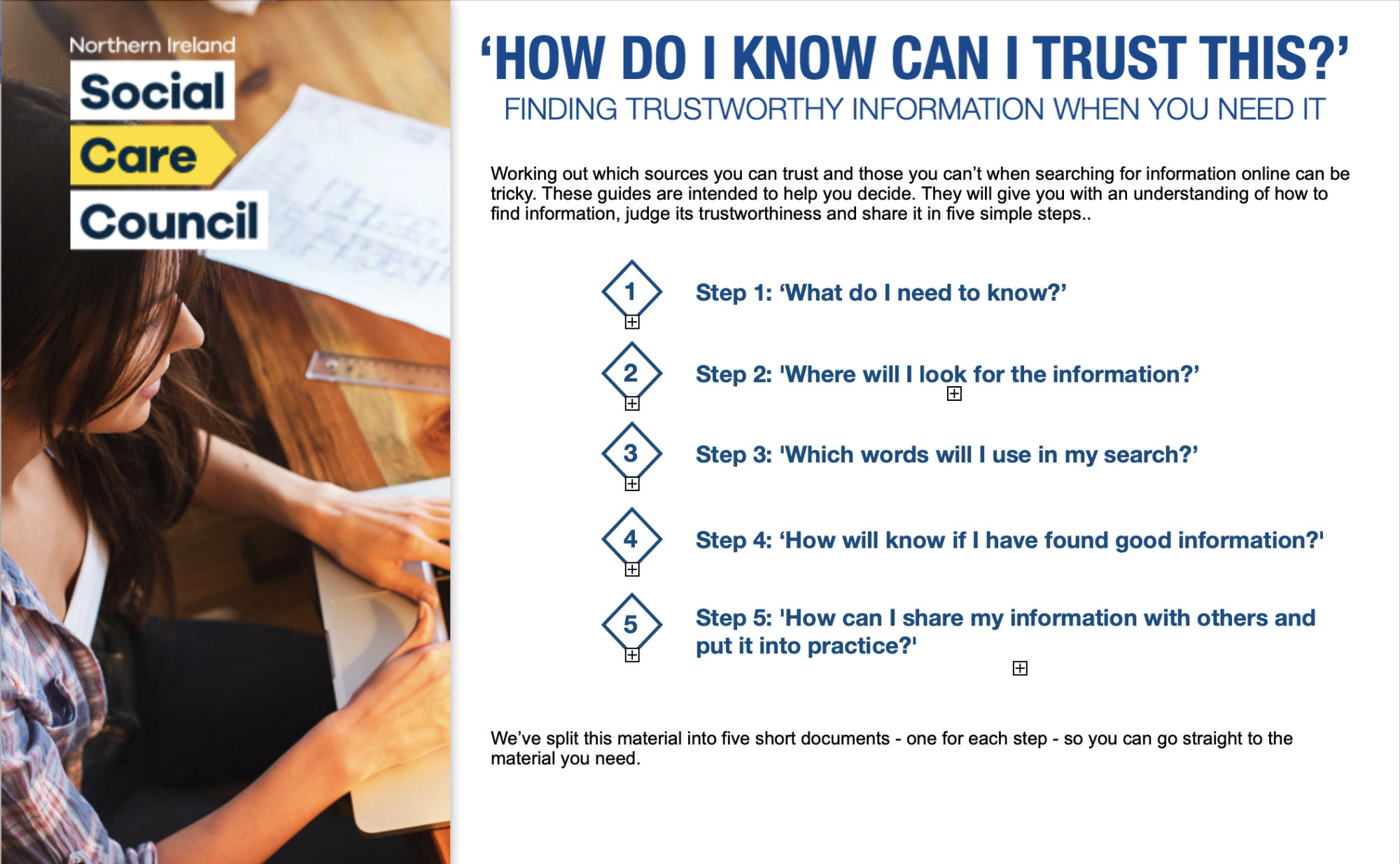
Click image to view full size
You can download the worksheets by clicking the links to each of them below:
- What do I need to know?
- Where will I look for the information?
- Which words will I use in my search?
- How will I know if I have found good information?
- How can I share my information with others and put it into practice?
Social work databases
Some of the key databases for social work professionals are listed below however, access may be restricted depending on licenses. Both Cochrane and Campbell databases are freely available and with a focus on systematic reviews and evidence synthesis they can be a useful starting point for any search. Cochrane and Campbell have very robust standards for producing systematic reviews and thus they tend to be of higher quality. For those working within HSC settings please see here for access to electronic databases for searching.
- The Cochrane Library: Collection of databases in medicine and other healthcare specialties provided by Cochrane and other organizations. /
- The Campbell Collaboration: this collaboration aims to produce systematic reviews and other types of evidence synthesis in the social and behavioural sciences. Its scope includes education, crime and justice, social welfare, and international development.
- The NICE (National Institute for Health and Care Excellence) Guidelines Database is a comprehensive resource that provides evidence-based recommendations for health and care in the UK, including best practices for disease management, treatments, and public health interventions. Its purpose is to improve the quality and consistency of care and health outcomes.
- ASSIA (Applied Social Sciences Index and Abstracts): Covers health, social services, psychology, sociology, economics, politics, race relations, and education.
- PsycINFO: Contains peer-reviewed literature in behavioural science and mental health.
- Social Care Online: The UK’s largest database of social care information (in December 2023 this will be combined with the Social Policy and Practice database (a subscription-based service).
- PubMed: A database of biomedical literature from MEDLINE, life science journals, and online books.
In addition to the source above, the Social Care Institute for Excellence (SCIE) and the Institute for Research and Innovation in Social Service (IRISS) also provide valuable and trustworthy information for social work and social care practitioners.
General tips and hints
- Use filters: Most databases allow you to apply filters, such as date range, article type, language, etc. These can be useful in narrowing down your search and making the results more manageable.
- Review Search Results: Now you can begin reviewing your search results. Start by reading the abstracts to see if the article is relevant. If it seems useful, read the full text.
- Document your Findings: Keep track of the articles you’ve found and any adjustments you’ve made to your search strategy. This will be helpful if you need to replicate or modify your search later.
- Assess the Quality of the Evidence: Use an appraisal tool to assess the quality of the research evidence. For example, the Critical Appraisal Skills Programme (CASP) provides various checklists to help you evaluate different types of studies.
- Synthesise the Evidence: Compile your research in a meaningful way that is useful for your practice. This may involve writing a summary, creating a table of findings, or formulating new guidelines based on the evidence.
- AI: Recent advancements have seen the emergance of AI-powered evidence synthesis tools to support research and policy decisions. As such, UKRI has invested in METIUS (Mobilising Evidence Through Artificial Intelligence and User-informed Synthesis), which aims to use AI to improve the speed, relevance, and accessibility of evidence synthesis for decision-makers, including in areas like health innovation. However, these tools should be used to complement, not replace, systematic searching expertise and critical appraisal.
Summary
Searching for research evidence is a vital skill for all social work professionals. This section provides guidance to help you find and evaluate the trustworthiness of information you find online, access academic research and bring evidence-based practice to your work in Northern Ireland. Remember, the goal is to use the best available evidence to inform your decision-making and ultimately improve the lives of the people you serve.
Reflective Learning Exercise
Complete the exercise below and keep a record of your reflections.
We are always interested in ensuring our resources are valuable tools for the workforce and are keen to hear your feedback, or ideas for future topics which could be included in this resource.
Photo by Charles Lamb on Unsplash